In today’s fast-moving digital world, modern electronics power everything from smartphones and smart TVs to industrial automation systems and renewable energy solutions. Behind the smooth operation of these devices lies a small yet powerful component — the capacitor.
Though compact in size, capacitors play a massive role in ensuring stability, efficiency, and performance in electronic circuits. Whether in consumer electronics, power supplies, automotive systems, or industrial machines, capacitors are fundamental building blocks of modern electrical engineering.
In this comprehensive guide, we will explore what capacitors are, how they work, their types, applications, and why they are essential in modern electronics.
What is a Capacitor?
A capacitor is an electronic component that stores and releases electrical energy in the form of an electric field. It consists of two conductive plates separated by an insulating material called a dielectric.
Basic Structure:
-
Two metal plates
-
Dielectric material (air, ceramic, film, electrolytic material, etc.)
-
External terminals
When voltage is applied, the capacitor stores energy by accumulating opposite charges on the plates. When needed, it releases this stored energy back into the circuit.
How Does a Capacitor Work?
The working principle of a capacitor is simple yet powerful.
-
Charging Phase – When connected to a power source, the capacitor accumulates electrical charge.
-
Storage Phase – The energy is stored in the electric field between the plates.
-
Discharge Phase – The capacitor releases energy when the circuit requires it.
This charge-discharge cycle happens extremely fast in most electronic devices, helping regulate voltage, filter signals, and improve overall performance.
Why Capacitors Are Important in Modern Electronics
Capacitors are essential because they:
-
Stabilize voltage supply
-
Reduce electrical noise
-
Improve power efficiency
-
Protect sensitive components
-
Enable signal processing
-
Assist in motor starting and speed control
Without capacitors, modern electronic devices would experience voltage fluctuations, overheating, unstable performance, and frequent failures.
Types of Capacitors Used in Electronics
Different applications require different types of capacitors. Here are the most commonly used ones:
1️⃣ Ceramic Capacitors
-
Small in size
-
Non-polarized
-
Used in high-frequency circuits
-
Common in smartphones and computers
2️⃣ Electrolytic Capacitors
-
High capacitance values
-
Polarized
-
Used in power supply circuits
3️⃣ Film Capacitors
-
Stable and reliable
-
Used in audio and signal processing
4️⃣ Tantalum Capacitors
-
Compact with high performance
-
Used in compact electronic devices
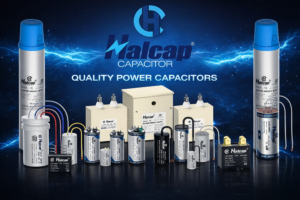
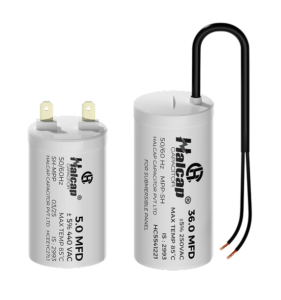
5️⃣ Motor Run & Start Capacitors
-
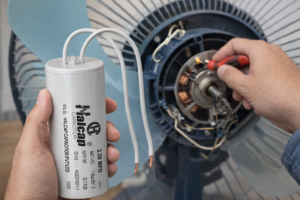
Used in fans, air conditioners, pumps
-
Help in motor starting and torque improvement
Each type serves a specific purpose depending on voltage requirements, temperature range, and circuit design.
Role of Capacitors in Power Supply Systems
One of the most important applications of capacitors is in power supply circuits.
✔ Voltage Smoothing
After AC is converted to DC, capacitors smooth out ripple voltage, ensuring steady output.
✔ Energy Backup
They provide short-term energy during sudden load changes.
✔ Surge Protection
Capacitors absorb sudden voltage spikes and protect components.
In computers, televisions, LED drivers, and chargers, capacitors ensure stable and efficient power delivery.
Capacitors in Motor Applications
In devices like ceiling fans, air conditioners, washing machines, and pumps, capacitors play a vital role.
They help in:
-
Motor starting
-
Improving torque
-
Maintaining speed
-
Reducing humming noise
-
Preventing overheating
Motor capacitors are especially important in regions with voltage fluctuations, as they help stabilize performance and extend motor life.
Capacitors in Communication and Signal Processing
Capacitors are widely used in:
-
Radio transmitters
-
Television circuits
-
Audio systems
-
Signal filters
They block DC while allowing AC signals to pass, making them crucial for filtering, coupling, and tuning circuits.
Capacitors in Renewable Energy Systems
With the rise of solar and wind energy systems, capacitors have become even more critical.
They are used in:
-
Inverters
-
Power conditioning units
-
Battery management systems
-
Energy storage modules
High-quality capacitors ensure improved efficiency, reduced losses, and longer equipment life in renewable energy installations.
Key Benefits of High-Quality Capacitors
Choosing the right capacitor offers several advantages:
🔹 Improved Energy Efficiency
Reduces unnecessary power consumption.
🔹 Enhanced Device Lifespan
Protects circuits from voltage stress.
🔹 Stable Performance
Ensures consistent output and smooth operation.
🔹 Reduced Maintenance Costs
Minimizes frequent component failures.
🔹 Better Thermal Stability
Operates efficiently under high temperatures.
In modern electronics, reliability depends heavily on capacitor quality.
Factors to Consider When Selecting a Capacitor
When choosing a capacitor, consider:
-
Capacitance value
-
Voltage rating
-
Temperature tolerance
-
ESR (Equivalent Series Resistance)
-
Application type
-
Physical size constraints
Selecting the wrong capacitor can lead to performance issues or even device failure.
Common Issues Caused by Low-Quality Capacitors
Using substandard capacitors can result in:
-
Bulging or leakage
-
Overheating
-
Reduced efficiency
-
Circuit instability
-
Shortened product lifespan
This is why manufacturers prioritize high-quality capacitors in modern electronic designs.
Future of Capacitors in Electronics
As technology evolves, capacitors are also advancing. Innovations include:
-
Supercapacitors for energy storage
-
High-voltage capacitors for EV systems
-
Miniaturized capacitors for compact electronics
-
Environment-friendly dielectric materials
With the growth of IoT, electric vehicles, automation, and smart infrastructure, the demand for advanced capacitor technology is rapidly increasing.
Conclusion
Capacitors may be small components, but their impact on modern electronics is enormous. From stabilizing power supplies and improving motor performance to enabling communication systems and renewable energy solutions, capacitors are indispensable in today’s world.
Understanding capacitors and their role in modern electronics helps engineers, manufacturers, and consumers appreciate the importance of choosing the right component for optimal performance and long-term reliability.
As electronic devices continue to become smarter and more energy-efficient, capacitors will remain at the heart of innovation and technological progress.